Your KPIs Look Great. Is the Business Any Better?
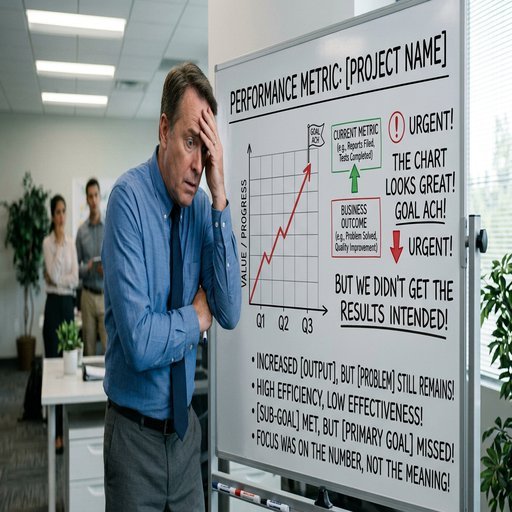
I’ve worked in operations where the KPIs were excellent and the business was not, where the KPIs were abysmal and the business was great, and, unfortunately, where there were no meaningful KPIs at all—which is basically driving at night with the headlights off.
I’m a numbers guy. I could look at numbers all day, pulling them apart, looking for trends, opportunities and potential problems.
But there’s something about KPIs that has always bothered me:
A good number doesn’t necessarily mean a good result.
You can hit every metric you’re chasing while missing the business entirely.
Work Toward the Goal, Not the Number
The whole reason we use KPIs is to measure ourselves toward a desired result. The problem starts when the KPI becomes the desired result.
Business models change. Customers change. Contracts change. Technology changes. Costs change. Operations change.
Yet somehow the same KPI can survive for ten years.
Why?
“Because that’s how we’ve always done it.”
There we go again with that one.
Every once in a while, take a KPI and ask a very simple question:
What exactly are we trying to achieve with this measurement?
If the answer isn’t clear, it’s time to dig a little deeper.
We Reweighed 80% of the Freight. Fantastic! Now What?
Here’s a real example from my career.
We operated a cross-dock facility and had a reweigh program to identify inaccurate shipment weights. Makes perfect sense. We’re moving freight as a service and we want to be paid fairly for what we’re moving.
A KPI was established:
Reweigh 80% of eligible freight.
The team hits 80%.
Green box on the report. Goal achieved. Everyone goes home happy.
Except I had another question:
Where’s the money?
When I dug into the results, the additional tonnage we were identifying wasn’t translating proportionally into additional revenue.
That didn’t sit well with me.
So I started asking why.
There were contract limitations, customer agreements, billing restrictions and, naturally, a few variations of “that’s just the way it’s done.”
We had successfully created a number that looked good.
But had we created value?
Those are two very different things.
One Number Can Tell a Much Bigger Story
The original KPI wasn’t bad. In fact, I thought it was a fantastic metric.
Stopping at 80% was the problem.
If we’re investing labor to reweigh freight, I want to know what we’re getting from that investment.
What’s the labor cost? Does the process slow down the cross-dock or affect service? How much additional billable revenue are we recovering? How much can’t we recover because of existing contract terms?
And what else can we do with the information?
Maybe repeated weight discrepancies become useful during the next contract negotiation. Maybe we identify customers consistently providing inaccurate weights and work with them to improve. Maybe we uncover additional revenue opportunities. Better weight information might also improve trailer utilization, load planning, equipment selection or costing.
Now that little 80% KPI is starting to become interesting.
We’re no longer measuring how much freight went across a scale.
We’re measuring what that information can do for the business.
Beware of Vanity KPIs
I call numbers that look impressive but don’t materially help the business vanity KPIs.
They make dashboards look healthy. They turn PowerPoint boxes green. They give everyone a positive number to point at.
But ask one more question and things can get uncomfortable:
“What did achieving this actually accomplish?”
If nobody has a good answer, you may not have a KPI.
You may have a decoration.
That doesn’t mean every KPI needs to produce revenue. Safety, quality, customer satisfaction, employee retention and many other outcomes are incredibly important.
But the measurement should connect to an intended result.
Otherwise, we’re just getting really good at counting things.
I Don’t Manage by Colors. I Manage by Questions.
I don’t believe good leaders simply review a KPI report, congratulate everyone because the boxes are green and move on.
A good KPI should start a conversation.
Why did it move? What caused it? What did it cost us? What business result did it influence? Can we actually do something with the information?
And perhaps most importantly:
Are we still measuring the right thing?
Sometimes a red KPI tells you exactly where your next opportunity is.
Sometimes a green KPI is hiding the problem.
That’s why:
I don’t manage by colors. I manage by questions.
I want to understand what’s driving the number, what it’s telling us and what we’re going to do with that information.
Measure What Matters
I love data, but there’s a big difference between having a lot of information and doing something useful with it.
The value comes when we turn data into information, information into decisions and decisions into results.
So occasionally take your favorite KPI—the one that’s been sitting comfortably on the monthly report for the last eight years—and give it a little interrogation.
Why do we measure you? What do you cost us? What decisions do you help us make? What business result do you influence?
If it has good answers, keep it.
If it doesn’t, maybe it’s time to thank it for its years of service and let it retire.
Because at the end of the day:
The goal isn’t to make the KPI look good.
The goal is to make the business better.